
Projectsmate
Architecture studios today operate under increasing pressure. Projects move faster, teams collaborate across locations, and clients expect higher levels of clarity and responsiveness. Most studios appear productive on the surface. Drawings are issued, meetings are held, and deadlines are met through sustained effort.
Yet many studios quietly feel that every new project demands more energy than it should. Familiar challenges require renewed coordination. Decisions need to be re explained. Context must be rebuilt again and again. Even experienced teams find themselves spending time reconnecting information instead of advancing the work.
This problem is rarely identified as a systemic issue. It is often explained as the natural complexity of architecture or the uniqueness of each project. In reality, a significant portion of productivity loss comes from repeatedly reinventing workflows, information structures, and coordination logic that should strengthen with experience, not reset each time.
Fragmented Workflows Quietly Drain Momentum
Modern architectural workflows are spread across many tools and communication channels. Drawings sit in shared folders, feedback arrives through emails and messages, and key decisions are often finalised during calls or meetings. Each tool serves a purpose, but together they form a fragmented system.
The challenge is continuity. Information becomes detached from its context as projects progress. Decisions lose traceability. Teams spend time searching for the latest inputs, confirming what is current, and revisiting why choices were made.
Research by McKinsey shows that knowledge workers spend close to 20 percent of their time searching for information or recreating existing work. In architecture, where coordination is layered and sequential, this hidden effort quietly erodes momentum rather than causing visible delays.
When workflows are fragmented, people are forced to compensate for the system. Instead of clarity being carried forward by structure, individuals must actively hold context together, increasing cognitive load and reducing creative focus.
Experience Fails to Compound Across Projects
Every architectural project produces valuable operational learning. Teams learn where coordination breaks down, which approvals slow progress, and where rework tends to occur. These insights are earned through real experience.
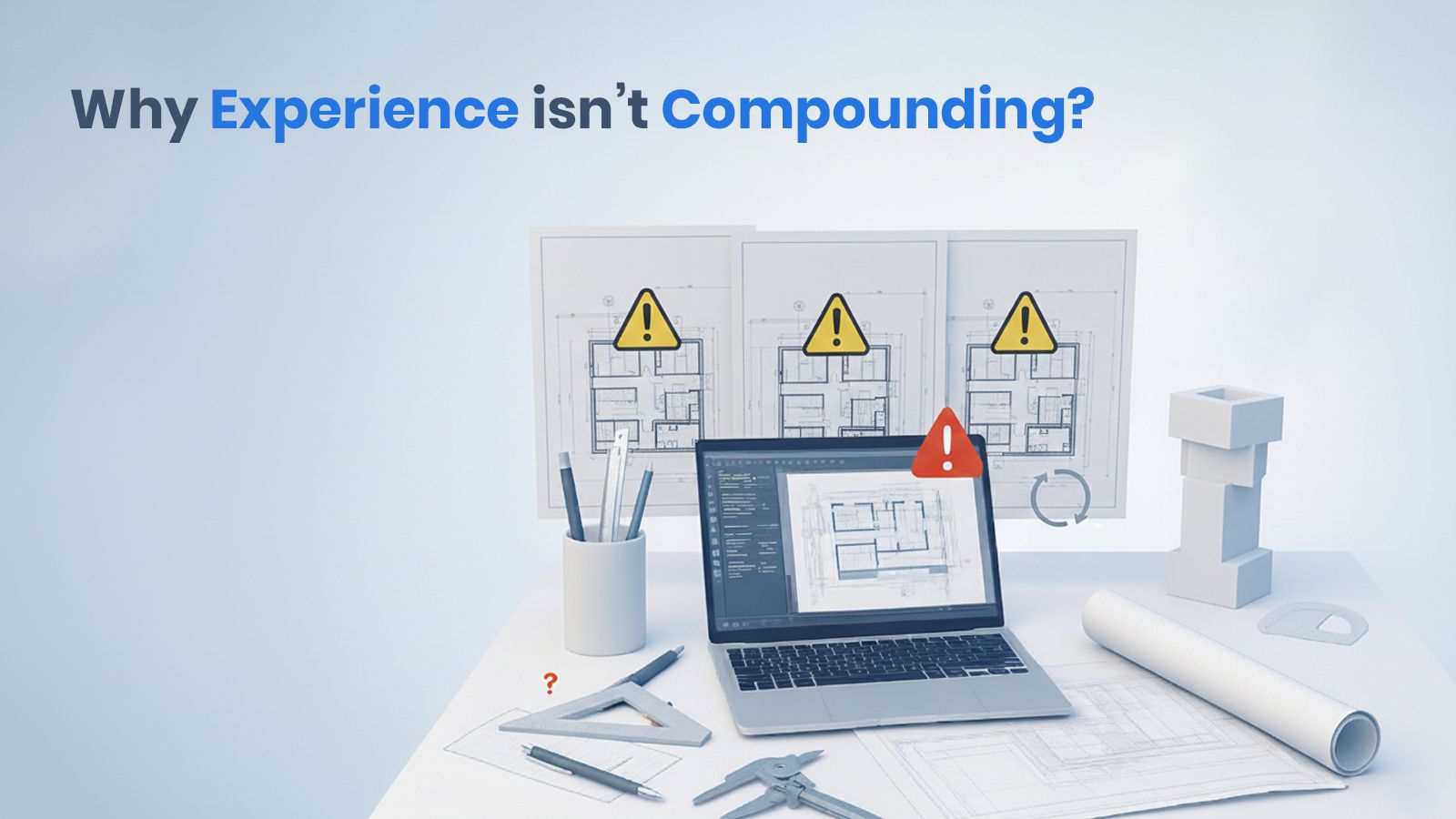
However, most studios lack a way to retain this learning structurally. When a project ends, files are archived but patterns are lost. Knowledge stays with individuals rather than becoming part of a shared operational foundation. As a result, similar challenges are approached repeatedly as if they were new.
This creates consistent internal patterns.
• Senior team members become the primary holders of project context
• New hires take longer to contribute independently
• Growth increases workload without increasing operational leverage
Deloitte research shows that organisations which systematically capture and reuse internal knowledge can improve productivity by up to 30 percent. In architecture, the absence of reuse keeps studios reliant on effort rather than efficiency, limiting long term scalability.
Productivity Loss Is Structural, Not Personal
When projects slow down, the instinctive response is often to focus on performance. Teams are asked to respond faster, communicate better, or attend more meetings. While well intentioned, this approach treats productivity as a behavioural issue.
In reality, productivity is shaped by structure. When information is scattered and decisions are hard to trace, even highly capable teams struggle to move with confidence. Time is spent reconstructing what has already happened instead of advancing what comes next.
The Project Management Institute reports that nearly one third of project failures stem from poor information flow and unclear ownership rather than lack of skill. Architecture studios are particularly vulnerable because small coordination gaps can create expensive downstream consequences.
Conclusion
Reinventing the wheel rarely feels dramatic. It appears as small inefficiencies, repeated clarifications, and a constant sense of catching up. Over time, this quietly erodes margins, exhausts teams, and limits a studio’s ability to grow sustainably.
Studios that perform consistently are not those that demand extraordinary effort from their people. They are the ones that treat workflow design as a strategic asset. By preserving context, surfacing patterns, and allowing learning to accumulate, they create conditions where productivity is supported by structure rather than sustained by effort alone.
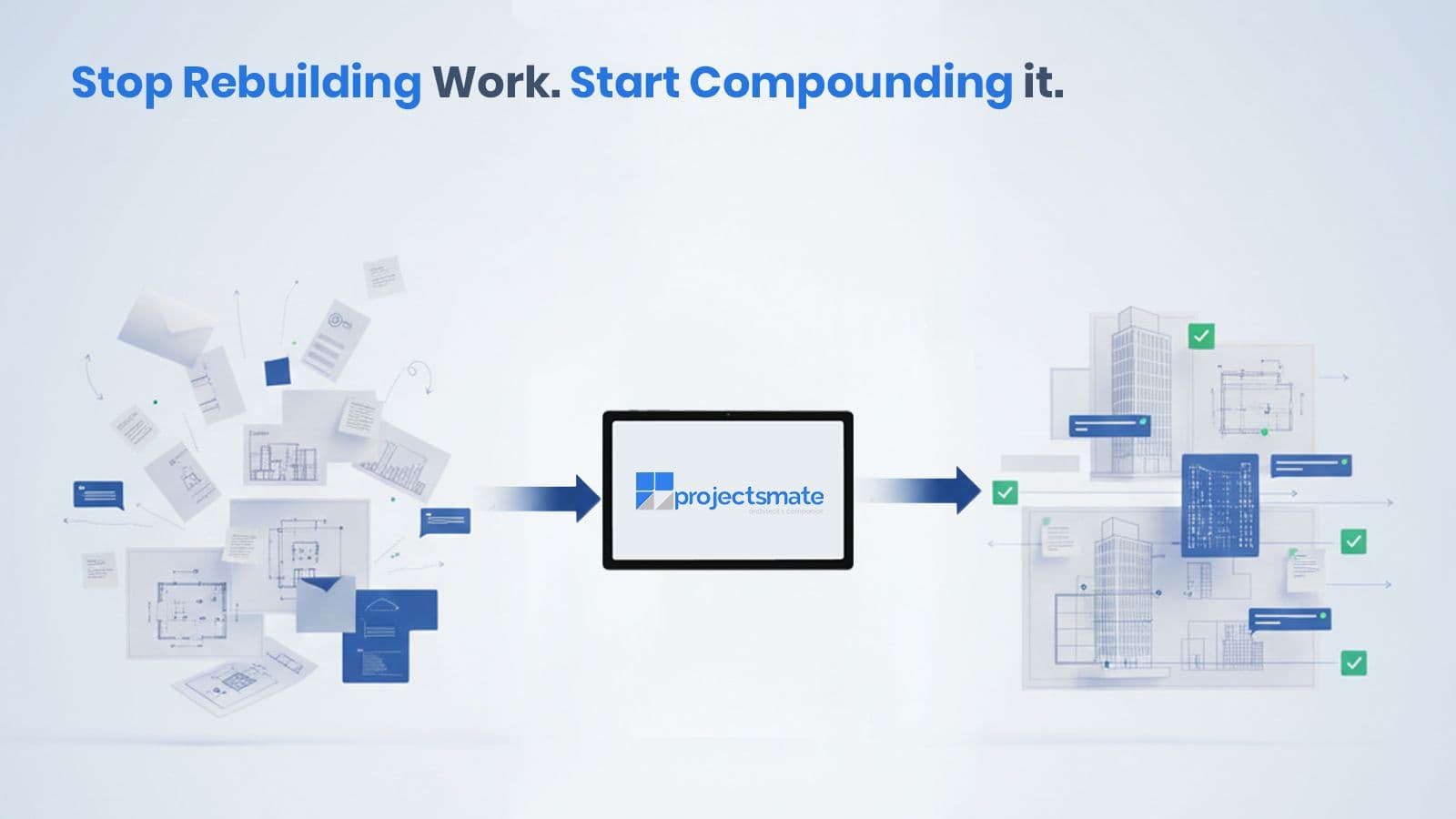
ProjectsMate is built to enable this shift. By centralising workflows, decisions, files, and project intelligence into a single connected system, ProjectsMate removes the need to rebuild coordination on every project. Studios gain visibility into what repeats, where friction forms, and how decisions flow over time. With technology reinforcing the structure of work, teams reclaim time, reduce friction, and build sustainable momentum with clarity and confidence on their side.