
Projectsmate
The Hidden Cost of Uncaptured Decisions in Architectural Workflows
One pattern that quietly shows up across many architectural projects is that failure rarely comes from one big mistake. It usually starts with small moments that feel harmless at the time like a quick verbal approval during a call, a minor change confirmed on a message or a drawing revision pushed forward because everyone seems aligned. In those moments, work moves fast and everything feels efficient.
What makes this hard to notice is that projects still look busy on the surface. Drawings are issued, coordination continues, and sites move ahead. The problem is not a lack of activity, but a lack of shared certainty. Over time, what was once a clear decision starts to depend on who remembers it, how they remember it, and which version they happened to be working on from that day.
This gap is growing in today’s AEC environment. Projects are faster, teams are more distributed, and clients are more involved than ever. More conversations create more decisions, but not all of them are anchored properly. When alignment depends mainly on memory and scattered tools, even strong teams begin to feel like they are constantly correcting course instead of confidently moving forward.
1. How Decision Debt Quietly Enters Architectural Workflows
It often begins at the exact point where something is agreed upon but not properly recorded. A layout is approved during a video call and the team immediately updates drawings. A material change is accepted in a chat message and assumed to be final. In the moment, it feels efficient to move quickly, and capturing the decision feels like something that can be done later.
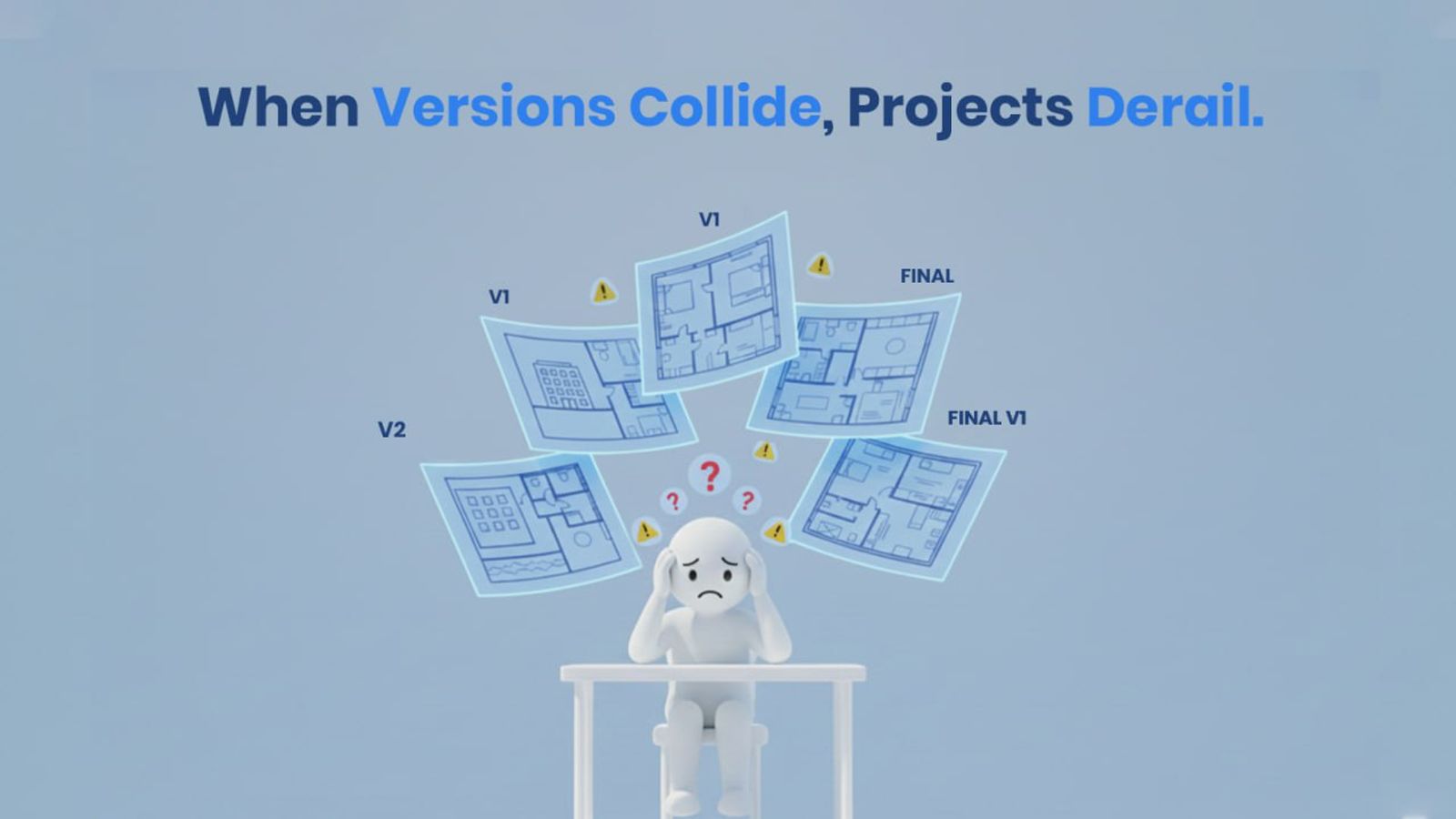
Over time, people slowly become the storage system for project intent. Senior architects tend to remember the reasoning behind changes, while junior team members mainly see the outcome. As drawings move through emails, shared folders, and site printouts, different versions quietly coexist. Site teams work from what they believe is current, while designers assume their latest issue is being used. None of this feels dramatic, but together it builds the conditions for confusion that nobody can easily trace back to its source.
2. The Business Damage Hidden Inside Rework and Decision Conflict
a) Profit erosion and rising risk
When rework appears, it is rarely labeled as a decision problem. It is often described as iteration or coordination effort. Yet many redraws are not created by new design thinking but by old decisions being interpreted differently. Those redraws still consume time, effort, and money, and under fixed fee structures, they quietly reduce margins without triggering any formal warning.
Something similar happens with risk. When intent is not clearly captured, responsibility becomes hard to define. During disagreements, everyone often feels justified because each side is operating from a different memory of what was agreed. What could have been resolved through a clear decision record slowly turns into negotiation driven by pressure instead of clarity.
b) Relationship breakdown and team burnout
Client relationships often strain not because of bad intent but because expectations blur over time. Clients remember conversations. Consultants rely on issued documents. When the two no longer match, trust begins to thin out. Each new discussion then carries the weight of past uncertainty rather than starting fresh.
Inside studios, the impact is quieter but just as heavy. Teams spend long hours correcting small misunderstandings that later grow into large revisions. Young architects often feel they are redoing work more than progressing it. Over time, this repeated cycle of correction rather than creation builds a fatigue that goes beyond workload and starts affecting motivation and retention.
3. How Technology Will Reshape Decision Control by 2026
a) Live decision capture and early risk signals
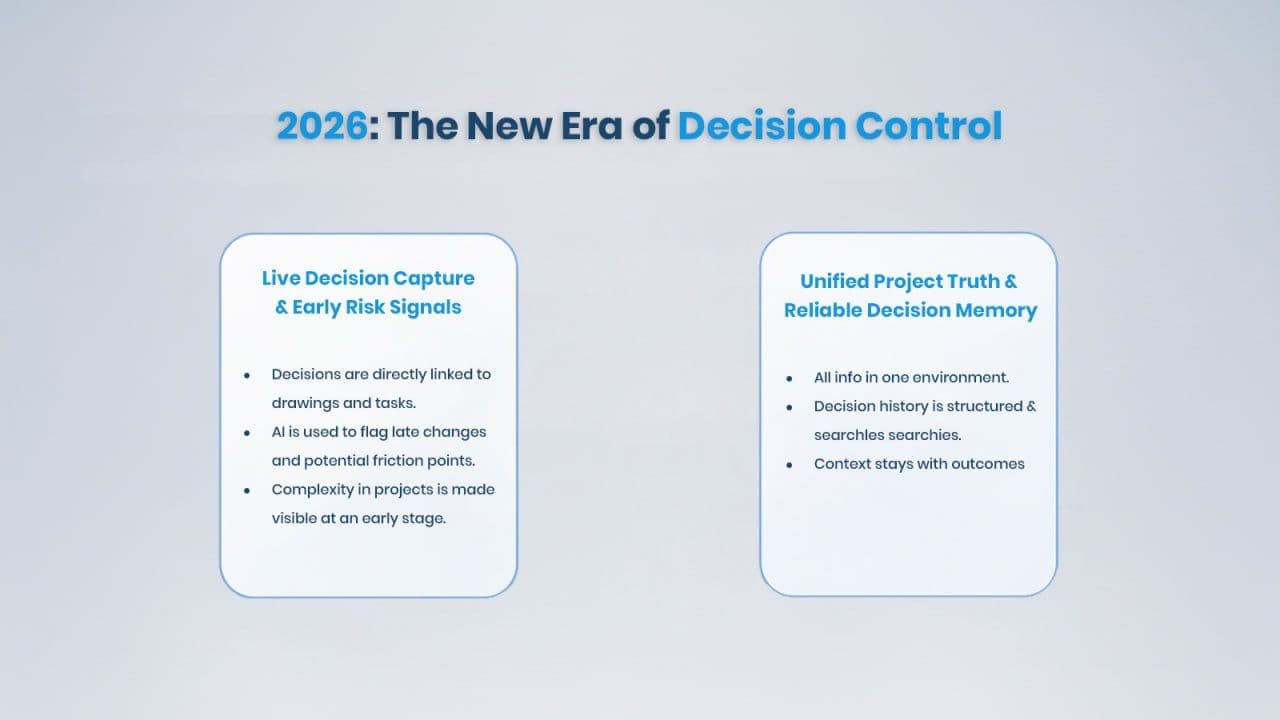
A noticeable shift already underway is that decisions are becoming part of the live project system rather than something documented afterward. Approvals, clarifications, and changes are beginning to attach directly to drawings, tasks, and timelines instead of floating in conversations.
As this grows, artificial intelligence is likely to be used less for automation and more for awareness. Patterns such as repeated late changes, frequent approval reversals, or persistent coordination friction between certain roles can be surfaced early. This does not remove complexity, but it does make it visible before it turns into unavoidable rework.
b) Unified project truth and reliable decision memory
Another shift is the movement away from scattered platforms toward environments where discussions, documents, site feedback, and approvals live together. The daily cost of fragmented truth is now visible to most teams, even if escaping it still feels difficult.
As decision history becomes structured and searchable, memory stops being the main source of truth. Intent gains a timeline. Context stays attached to outcomes. Over time, this changes how accountability feels. It becomes less personal and more factual, which often reduces tension rather than increasing it.
Conclusion
What becomes clear after observing enough projects is that decision capture quietly shapes everything that follows. It influences how much rework a team absorbs, how many misunderstandings surface, and how often people feel like they are correcting instead of creating. Teams that rely heavily on memory and informal confirmations tend to carry more invisible friction than they realize, until that friction shows up as delay, fatigue, or conflict.
There is also a subtle shift in how trust forms when intent is recorded alongside action. Trust stops depending entirely on personal recall and starts resting on shared clarity. Conversations become lighter because fewer things need to be defended later. Disagreements still happen, but they resolve faster because the past is visible rather than debatable.
This is where ProjectsMate fits naturally into the evolving workflow as a shared memory for the project itself. By allowing decisions, approvals, and changes to live where the work lives, it reduces the burden on people to constantly remember and reinterpret. As architecture continues to move faster and grow more interconnected, creativity will always remain essential, but the ability to clearly remember what was decided, when it was decided, and why it was decided is becoming the foundation for calm, confident, and sustainable practice.