
Projectsmate
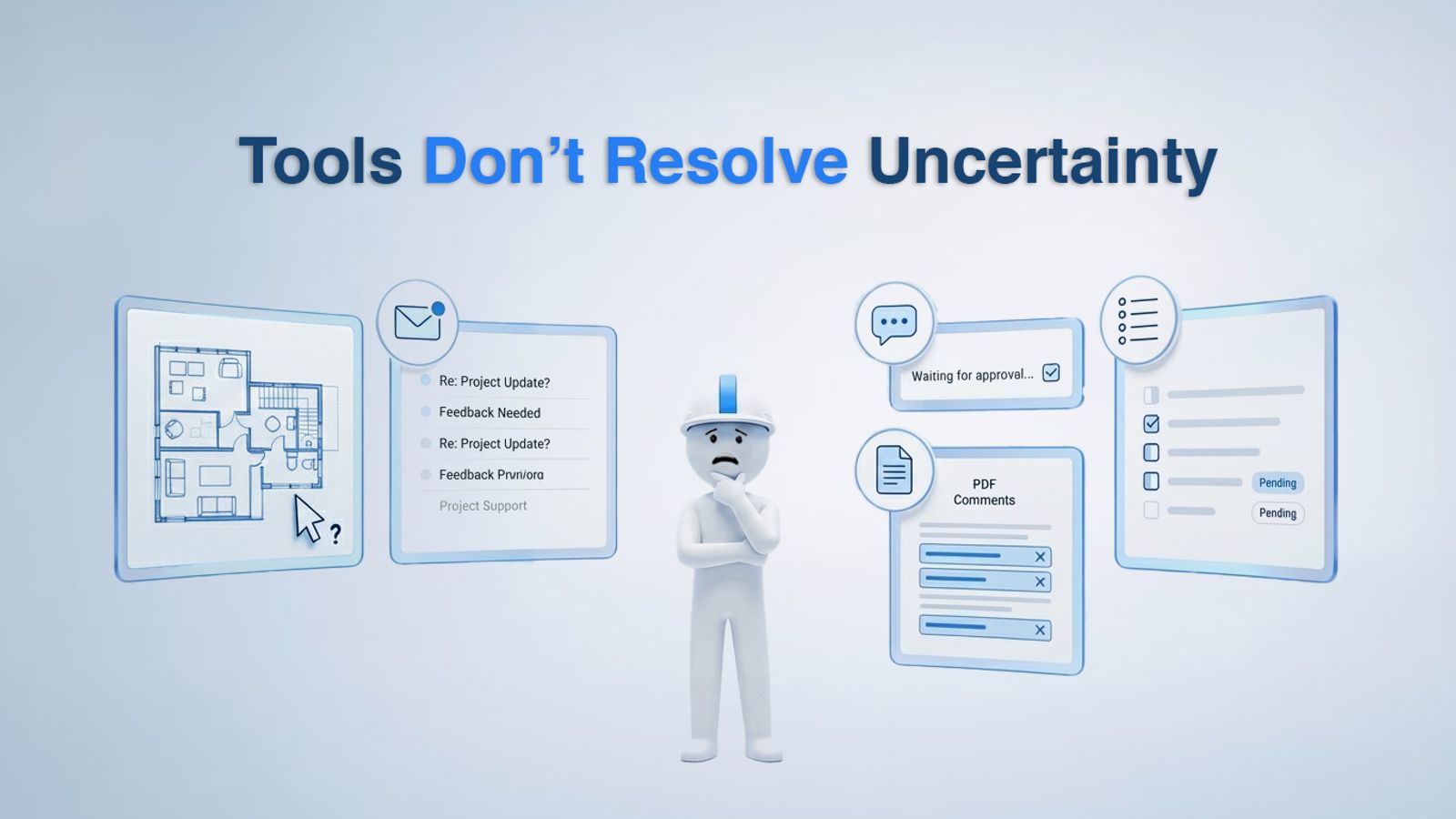
Architecture studios today use more digital tools than ever before. Different software supports drawings, communication, documentation, and coordination at various stages of design and delivery. On paper, this suggests a well-supported workflow.
In practice, many studios experience the opposite. Projects require repeated clarification. Decisions resurface unexpectedly. Teams spend time confirming information that should already be settled. Despite the number of tools in use, work often feels heavier and more fragmented than it should.
This points to a deeper issue. Most studios are not slowed down by a lack of tools. They are slowed down by unresolved questions that quietly accumulate as projects progress.
Unresolved Questions Accumulate Invisibly
Unresolved questions rarely appear as obvious problems. They show up as small uncertainties that are easy to defer in the moment. Was this option approved or merely discussed. Is this the latest drawing, or just a working version. Who is responsible for closing this item, and when.
Individually, these questions seem minor. Teams assume they will be clarified later or resolved informally. Over time, however, they begin to stack up. As projects move forward, unanswered questions travel with the work and resurface at later stages, when the cost of uncertainty is much higher.
In architecture, where decisions are sequential and interdependent, this lack of closure creates friction that is difficult to trace back to a single source. Progress continues, but confidence in the work gradually erodes.
Tools Multiply When Clarity Is Missing
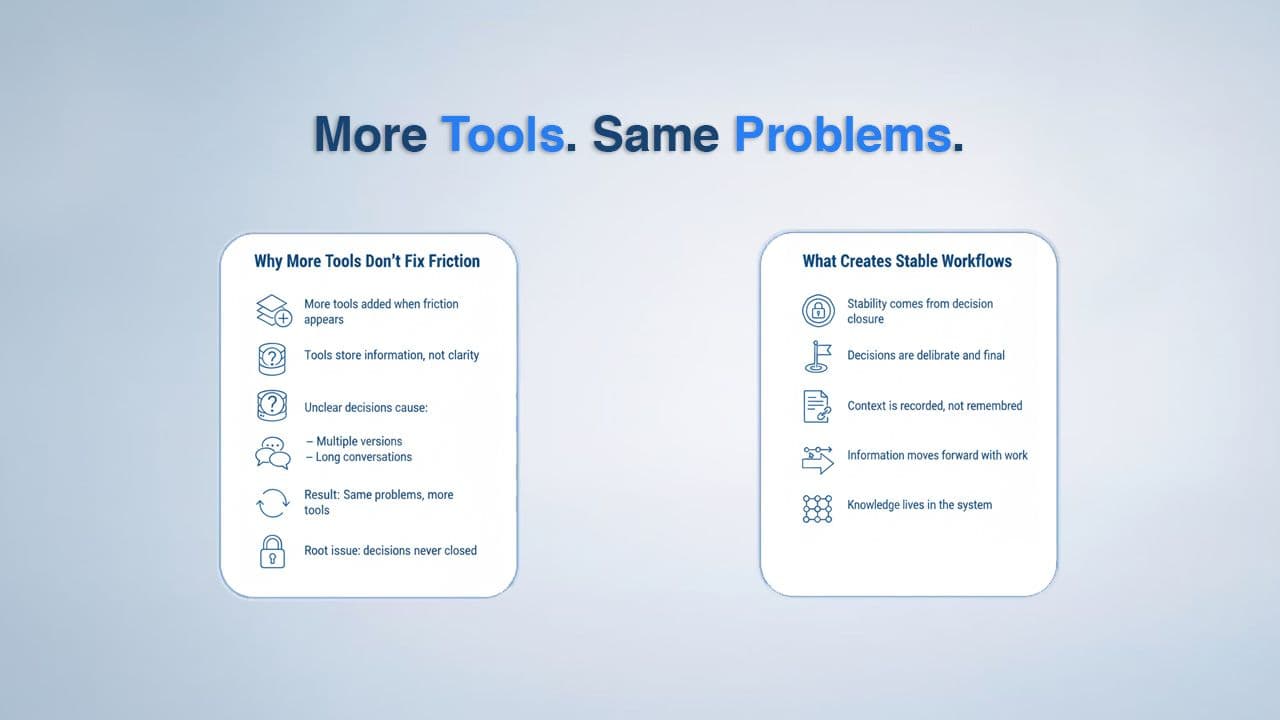
When teams sense this friction, the natural response is to introduce more structure. A new tracking sheet, another communication channel, or an additional tool to manage updates. Each addition is intended to restore clarity and control.
However, tools are designed to store and transmit information, not to resolve ambiguity.
When decisions remain unclear, tools simply preserve that uncertainty in another form. Multiple versions coexist. Conversations extend without resolution. Information becomes easier to record but not easier to trust.
As a result, studios often find themselves managing an expanding ecosystem of tools while still struggling with the same coordination issues. The problem is not the number of tools. It is that tools are being used to compensate for questions that were never properly closed.
Decision Closure Shapes Workflow Stability
In studios where work feels steady, the difference is not simpler projects or fewer tools. It is a higher degree of decision closure. Key choices are made deliberately and treated as final unless explicitly revisited. Changes are recorded with context. Responsibilities are clear enough that progress does not depend on constant follow-ups.
This creates continuity. Information carries forward with the work rather than needing to be reconstructed. Teams spend less time reorienting themselves and more time advancing the project.
When decision closure is absent, individuals compensate. Senior team members hold context in their heads. Founders bridge gaps manually. New team members rely on informal explanations to understand past choices. Over time, this reliance on personal memory becomes a structural risk.
The Hidden Cost of Open Loops
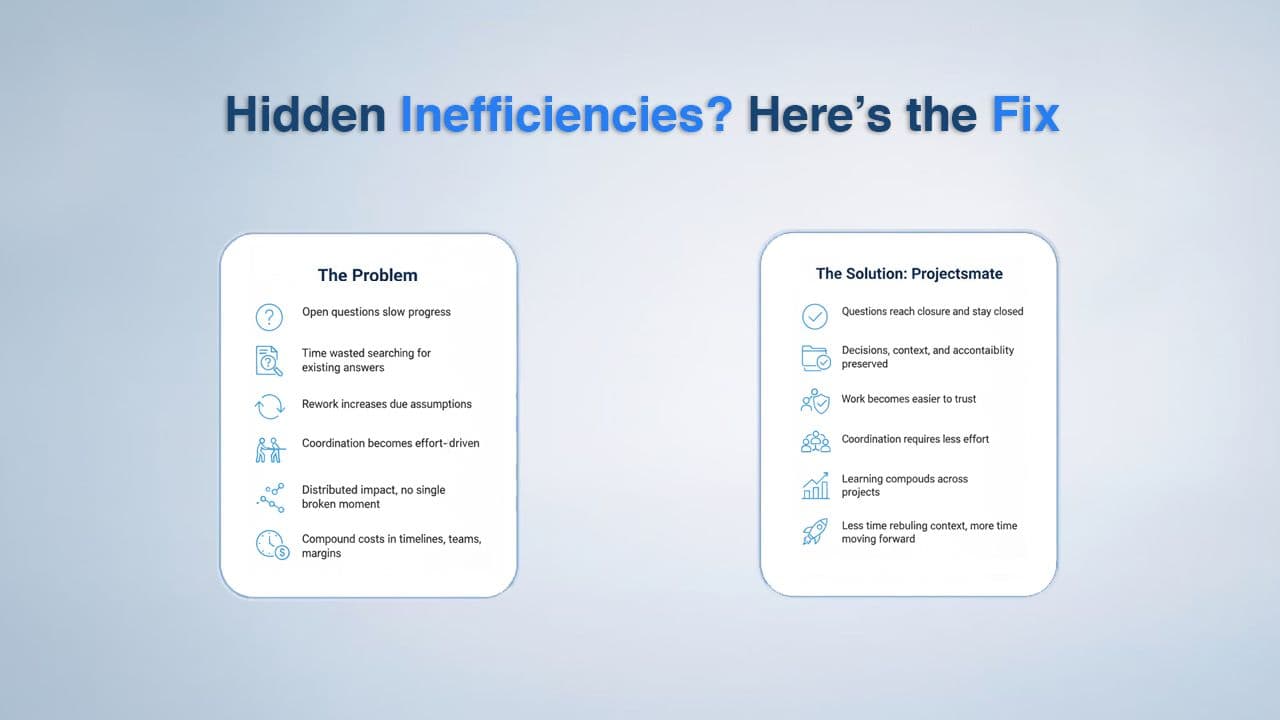
Open questions rarely cause immediate failure. Instead, they create background inefficiency. Time is spent searching for answers that should already exist. Rework increases as assumptions replace clarity. Coordination becomes effort-driven rather than system-supported.
Across knowledge-intensive industries, poor information flow and unclear ownership are consistently linked to productivity loss. In architecture, where downstream consequences can be expensive, these small inefficiencies compound quickly.
What makes this difficult to address is that the impact is distributed. No single moment feels broken. The cost appears gradually, in stretched timelines, pressured teams, and reduced margins.
Conclusion
Architecture studios do not need endless layers of new tools to operate effectively. They need ways to help questions reach closure and stay closed as work moves forward. Without this, tools multiply while clarity declines.
Studios that invest in preserving decisions, context, and accountability experience a different kind of efficiency. Work becomes easier to trust. Coordination requires less effort. Learning begins to compound across projects instead of resetting each time.
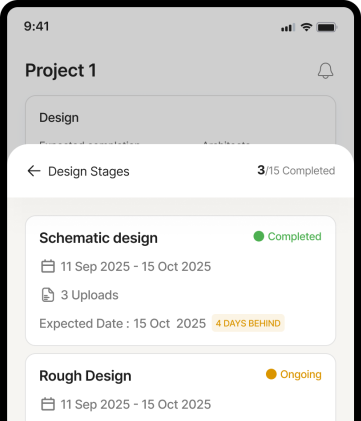
Projectsmate is built around this idea. Instead of adding another isolated tool, it focuses on holding decisions, updates, files, and responsibilities together as projects evolve. By reducing unresolved questions across the lifecycle of work, studios spend less time rebuilding context and more time moving forward with confidence.