
Projectsmate
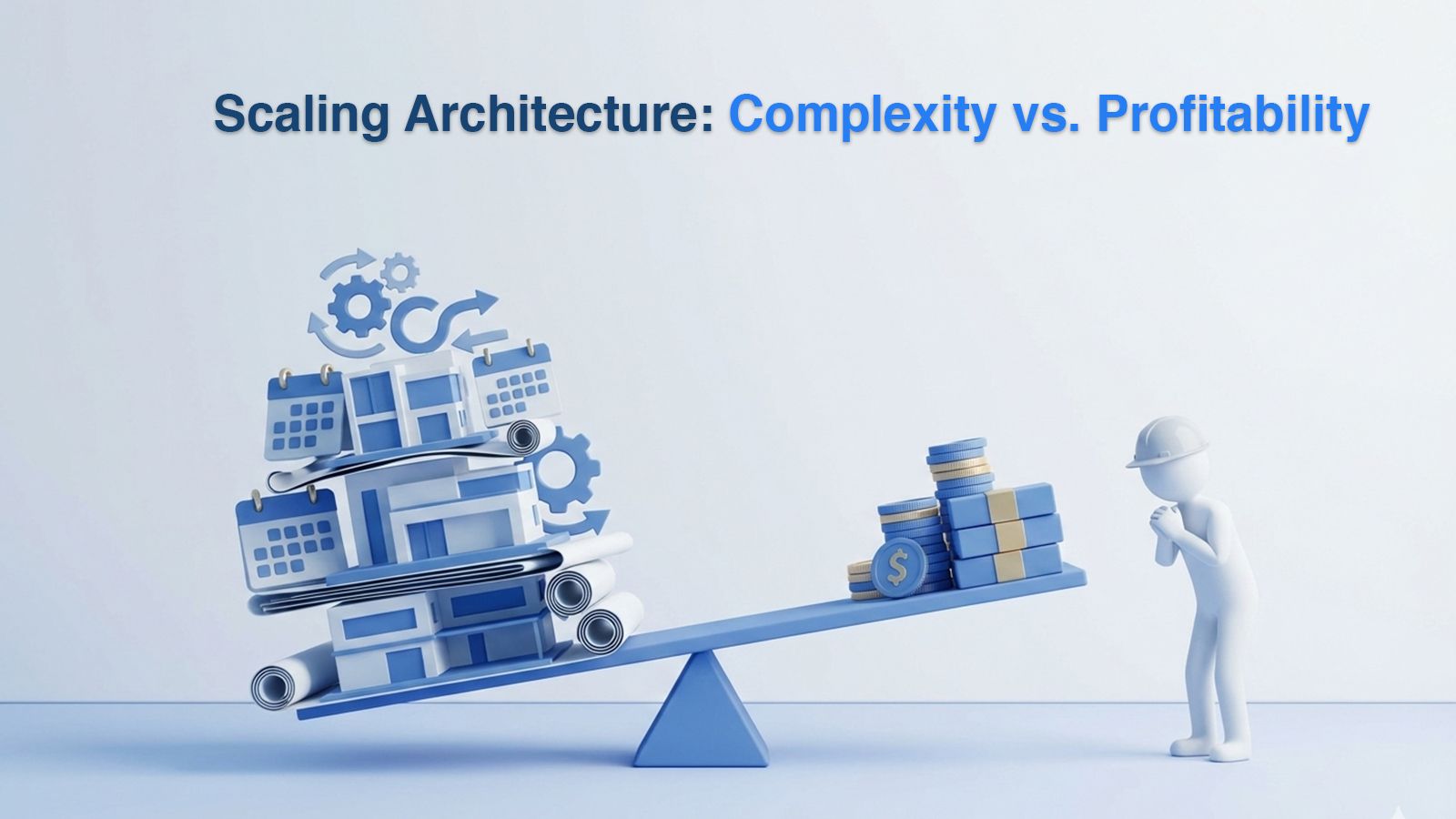
As architecture studios grow, complexity often increases faster than profitability. More projects come in, teams expand, and the volume of coordination rises quickly. From the outside, this looks like healthy progress. Internally, however, many studios begin to feel stretched long before the financial upside of growth becomes visible.
Studios find themselves managing more conversations, more dependencies, and more decisions without a corresponding improvement in margins or stability. Workloads increase, pressure rises, and founders often wonder why growth feels heavier than expected. This imbalance is rarely intentional, yet it is remarkably common across practices of different sizes.
The reason lies not in ambition or capability, but in how complexity enters a studio’s operating model.
Complexity Grows Faster Than Structure
In the early stages of a practice, coordination relies heavily on proximity and shared understanding. Founders are involved in most decisions, teams are small, and context travels quickly through informal conversations. This creates a sense of control, even when systems are light.
As studios take on more work, this informal model begins to strain. Each additional project introduces new timelines, new stakeholders, and new points of dependency. Each new hire increases the need for alignment, clarity, and consistency across decisions that were once handled instinctively.
This growth in complexity happens immediately. Fee structures, pricing assumptions, and delivery models, however, tend to remain unchanged. Studios absorb the additional coordination effort internally, often without revisiting whether their operating model is still appropriate for the scale of work they are now handling.
The result is a widening gap between how complex the studio has become and how it is compensated for managing that complexity.
Effort Temporarily Masks Structural Inefficiency
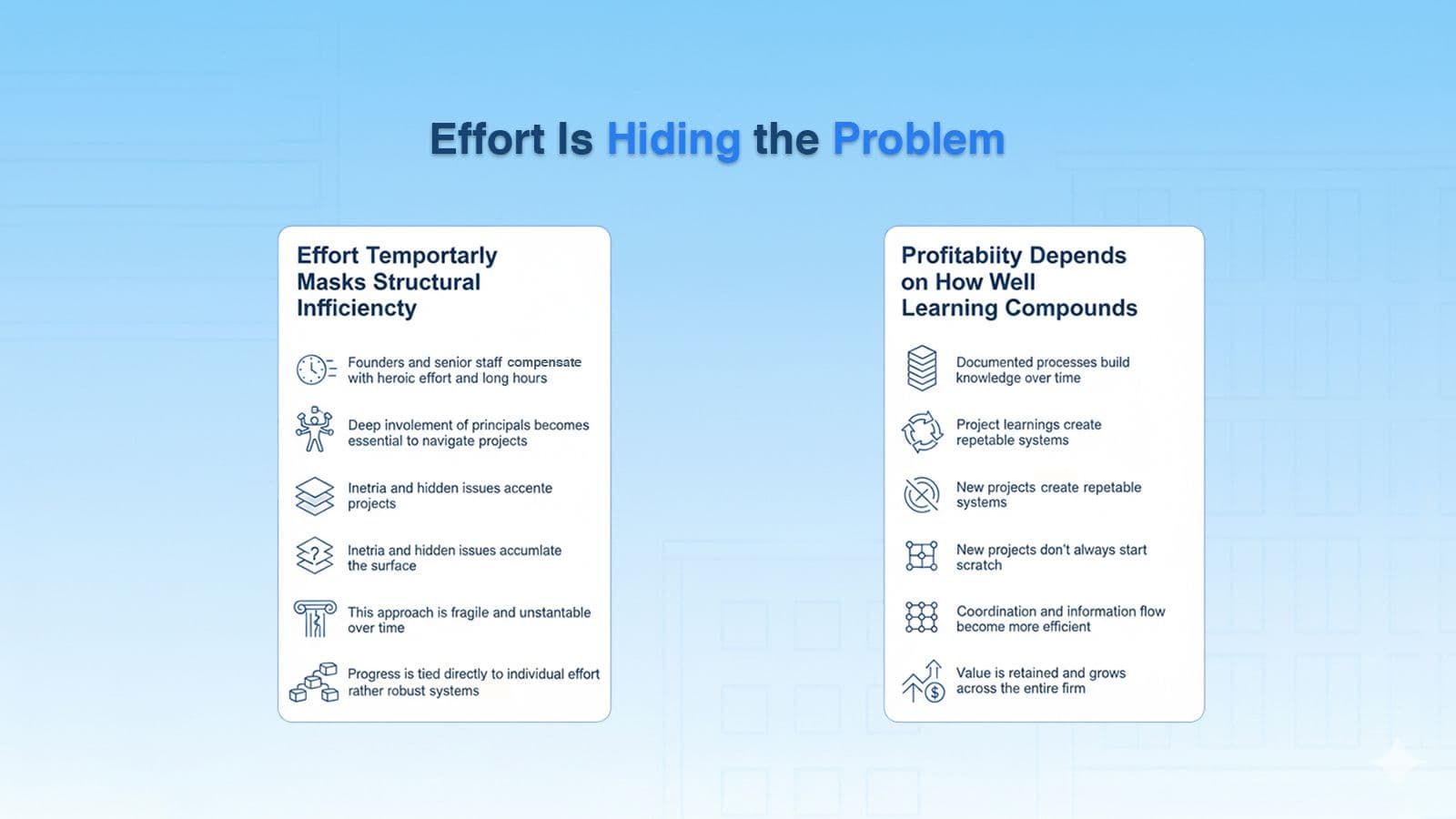
Many studios respond to this gap by increasing effort. Teams work longer hours, founders stay deeply involved, and problems are solved through responsiveness rather than design. This keeps projects moving and clients satisfied in the short term.
Because delivery continues, inefficiencies remain largely invisible. Time spent clarifying decisions, reconnecting information, or resolving preventable rework rarely appears as a clear cost. It is distributed across people and absorbed into daily work.
Over time, however, this effort-driven model becomes fragile. Margins tighten as more energy is required to deliver the same outcomes. Founders find themselves pulled into operational problem-solving instead of strategic thinking. Growth brings more responsibility, but not more leverage.
What initially feels like dedication slowly turns into dependency on sustained effort.
Profitability Depends on How Well Learning Compounds
Sustainable profitability in architecture does not come from working harder on each project. It comes from reducing how much effort is required to deliver consistent results over time. This depends on whether learning compounds across projects.
In many studios, experience improves judgment but not efficiency. Teams know what to look out for, but they still rebuild coordination from scratch. Decisions are revisited, workflows are reassembled, and similar problems are solved repeatedly without structural reinforcement.
When coordination is not repeatable, every project behaves like a first project. As complexity increases, the cost of this reset grows. More people are involved, more time is spent aligning, and more value leaks through small gaps in decision-making and ownership.
Profitability suffers not because fees are inherently too low, but because too much effort is required to earn them.
Founders Absorb the Cost of Unmanaged Complexity
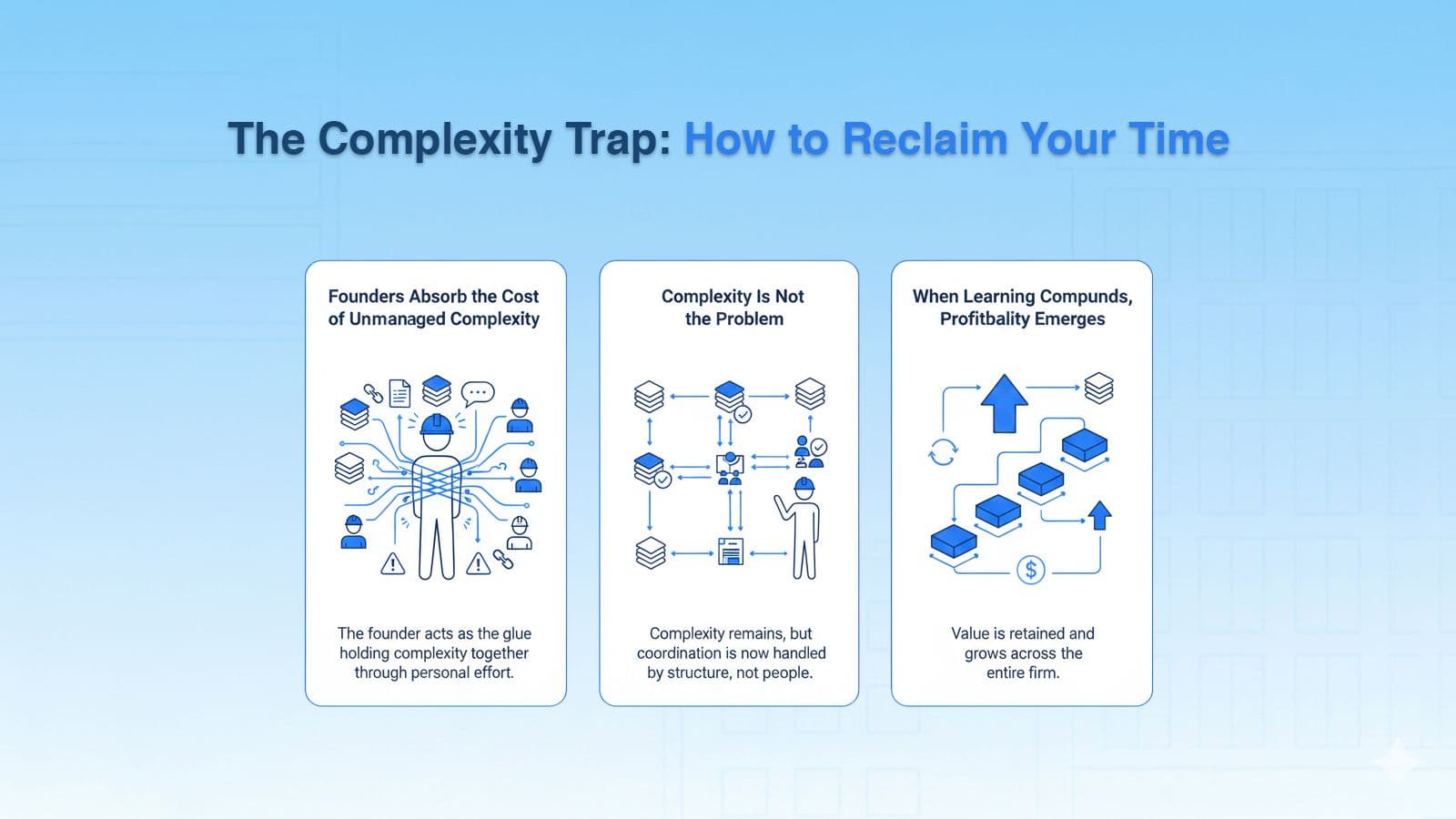
As studios grow, founders often become the stabilising force that holds everything together. They reconnect context, resolve ambiguities, and step in when coordination breaks down. This keeps work moving, but it creates a hidden dependency.
The studio’s ability to function smoothly becomes tied to the founder’s availability. Visibility
decreases as workload increases. Decisions concentrate at the top, not by design, but by necessity. Over time, this limits the studio’s ability to scale without increasing personal strain.
This is not a failure of leadership. It is a predictable outcome of complexity increasing faster than the systems designed to manage it.
Complexity Is Not the Problem
Complexity itself is not the enemy. Architecture is inherently complex, and good studios learn to work with that reality. The issue arises when complexity outpaces a studio’s ability to handle it deliberately.
Studios that remain profitable as they grow are not simpler. They are clearer. They invest in how decisions are made, recorded, and carried forward. They reduce the effort required to coordinate work, not by enforcing rigid processes, but by preserving context and closing loops consistently.
This allows experience to compound. Each project strengthens the next. Effort begins to scale more slowly than output, creating room for profitability to emerge.
Conclusion
When complexity outpaces profitability in architecture studios, the cause is rarely ambition or mismanagement. It is usually the absence of structures that allow complexity to be handled without constant effort.
Profitability follows when coordination becomes easier, not when people work harder. Studios that recognise this early are better positioned to grow without exhausting their teams or their founders.
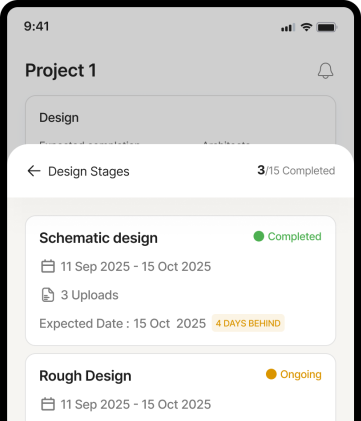
Projectsmate is built to support this transition. By bringing decisions, workflows, files, and project context into a connected system, it helps studios manage complexity without relying on individual effort. Instead of rebuilding coordination on every project, studios gain continuity, visibility, and the ability to let experience compound into sustainable profitability.