
Projectsmate
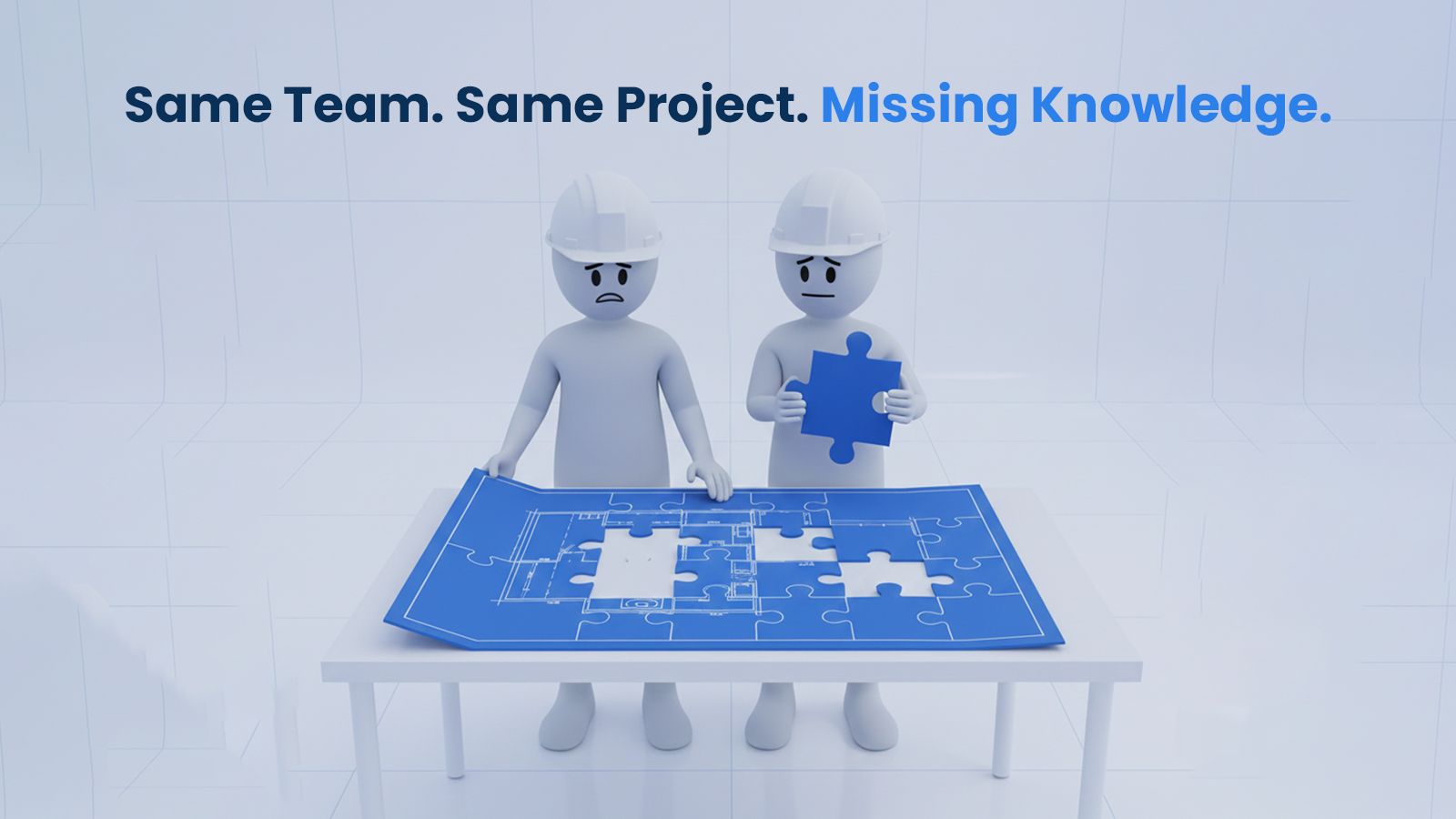
In architecture studios, experience is everything. Design intelligence, technical decisions, client history, and site knowledge build quietly over time, shaping how projects move from concept to construction. Yet across the industry, much of this knowledge never becomes part of the studio’s institutional memory. Instead, it remains scattered across people’s minds, buried in emails, personal notebooks, chat threads, and half-remembered conversations.
This fragmentation creates a dangerous gap. As teams evolve, seniors move between projects, and consultants rotate, vital context slowly disappears. What remains is a project team forced to reconstruct understanding from fragments, often long after critical decisions were made. The result is more than inefficiency. It is systemic fragility.
Internal knowledge transfer has quietly become one of the most significant barriers to scaling architectural practice.
The Problem With Informal Handover
Most architecture studios still rely on informal handovers. A project lead briefs the next team in a quick meeting. A senior architect forwards a few files. Someone says, “Everything you need is in the old drawings. ”This is almost never the case and we cannot help it.
Critical information is rarely captured in one place. Design intent, client sensitivities, site constraints, consultant agreements, unresolved risks, regulatory nuances, and construction history are dispersed across people, tools, and time. When even one key individual steps away, that context weakens. When several change at once, the project’s memory collapses.
This is not a failure of individuals. It is a structural weakness in how most studios operate.
Where Knowledge Breaks Down
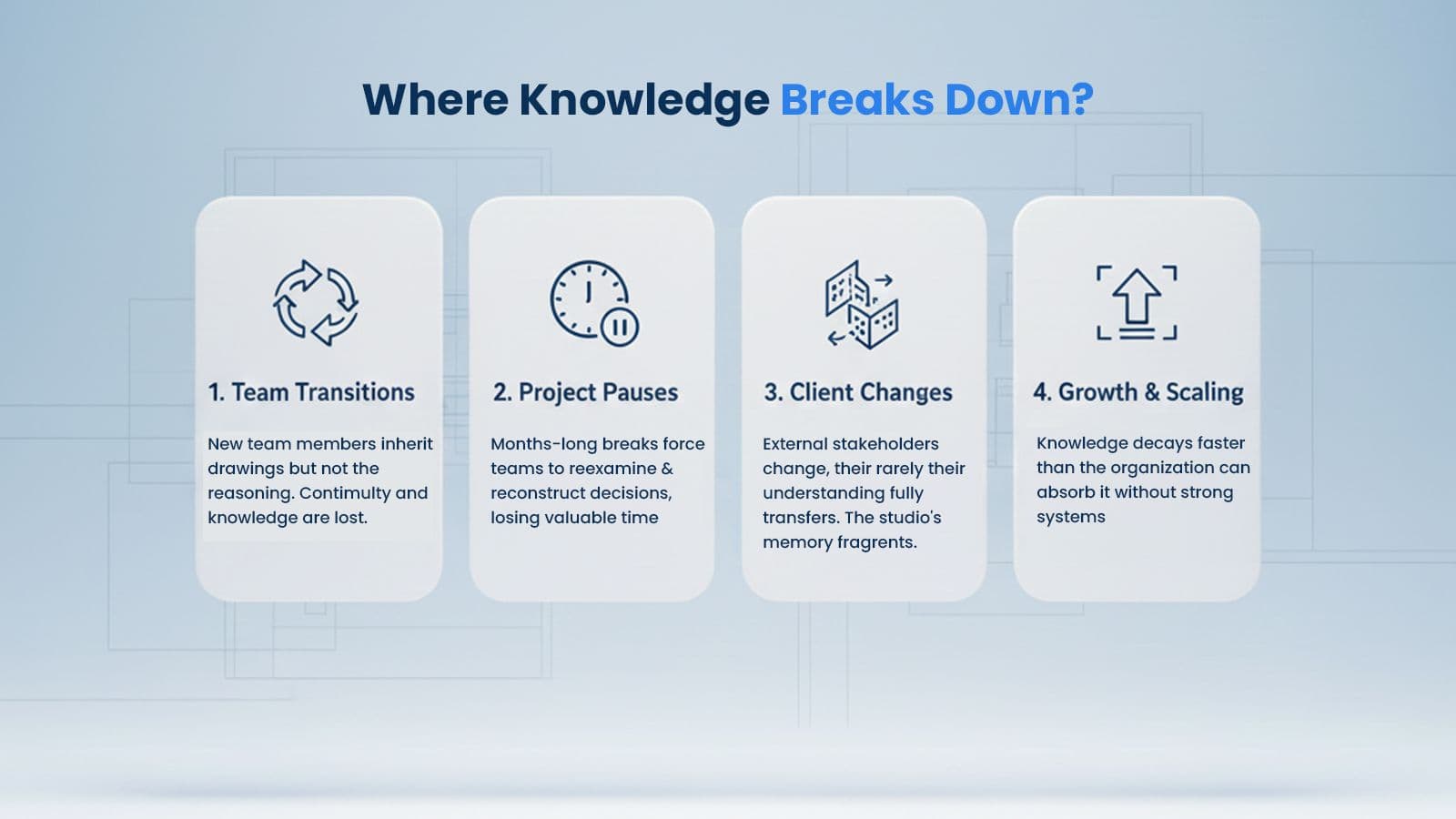
Knowledge loss follows a familiar pattern across studios.
1. Team Transitions
When juniors rotate or seniors shift to new commissions, continuity breaks. New team members inherit drawings but not the reasoning behind them. They know what was done, but not why it was done.
2. Project Pauses and Restarts
Projects often pause for months. When they restart, teams struggle to reconstruct earlier decisions, agreements, and risk assumptions. Valuable time is lost rediscovering information that once existed.
3. Consultant and Client Changes
When external stakeholders change, their understanding rarely transfers cleanly. The studio becomes the memory keeper, yet its own memory remains fragmented.
4. Growth and Scaling
As studios grow, founders and senior designers can no longer personally carry project knowledge. Without strong systems, knowledge decays faster than the organization can absorb it.
Each of these moments increases rework, weakens delivery confidence, and quietly inflates operational costs.
Why This Limits Scalability
Studios that depend on informal knowledge transfer eventually hit a ceiling.
They cannot safely increase project volume because every new commission depends on personal memory. They cannot build predictable delivery because context constantly leaks. They cannot decentralize leadership because knowledge is not portable.
The consequences are clear:
- Inconsistent project outcomes, even with strong design talent
- Heavy dependence on a few key individuals
- Rising coordination costs as teams spend more time rediscovering information than producing new work
At a certain scale, the studio becomes fragile. One departure or miscommunication can disrupt entire project pipelines. This is when many firms feel busy, but stuck.
Why More Tools Don’t Fix It
Studios already use many tools: drawing platforms, document management systems, messaging apps, email, and project trackers. But tools do not create knowledge. They simply store fragments.
True knowledge transfer requires:
- Structured documentation of decisions
- Clear ownership of context
- Shared visibility into evolving project intent
- Continuity across time and teams
Without these foundations, studios accumulate more data without building real institutional intelligence.
From Personal Memory to Studio Memory
High-performing studios treat knowledge as a core operational asset.
They design workflows where decisions, assumptions, constraints, risks, and agreements are captured as the project unfolds, not reconstructed later. They reduce dependence on individual memory by making project context visible, searchable, and continuously updated.
This shift does not slow creativity. It protects it.
Design teams spend less energy realigning and more energy designing. Leaders spend less time firefighting and more time building the practice. Clients experience steadier delivery and clearer communication.
Knowledge becomes something the studio owns, not something it repeatedly loses.
Why This Matters Now
The AEC industry is accelerating. It is more regulated, more collaborative, and more complex than ever. Teams are increasingly distributed. Clients are less tolerant of delays and mistakes.
In this environment, studios that cannot reliably transfer knowledge will struggle to compete. Those that can will move faster, scale healthier, and build lasting advantage.
Building Knowledge Into the System
This is where modern studio operating systems like ProjectsMate change the equation.
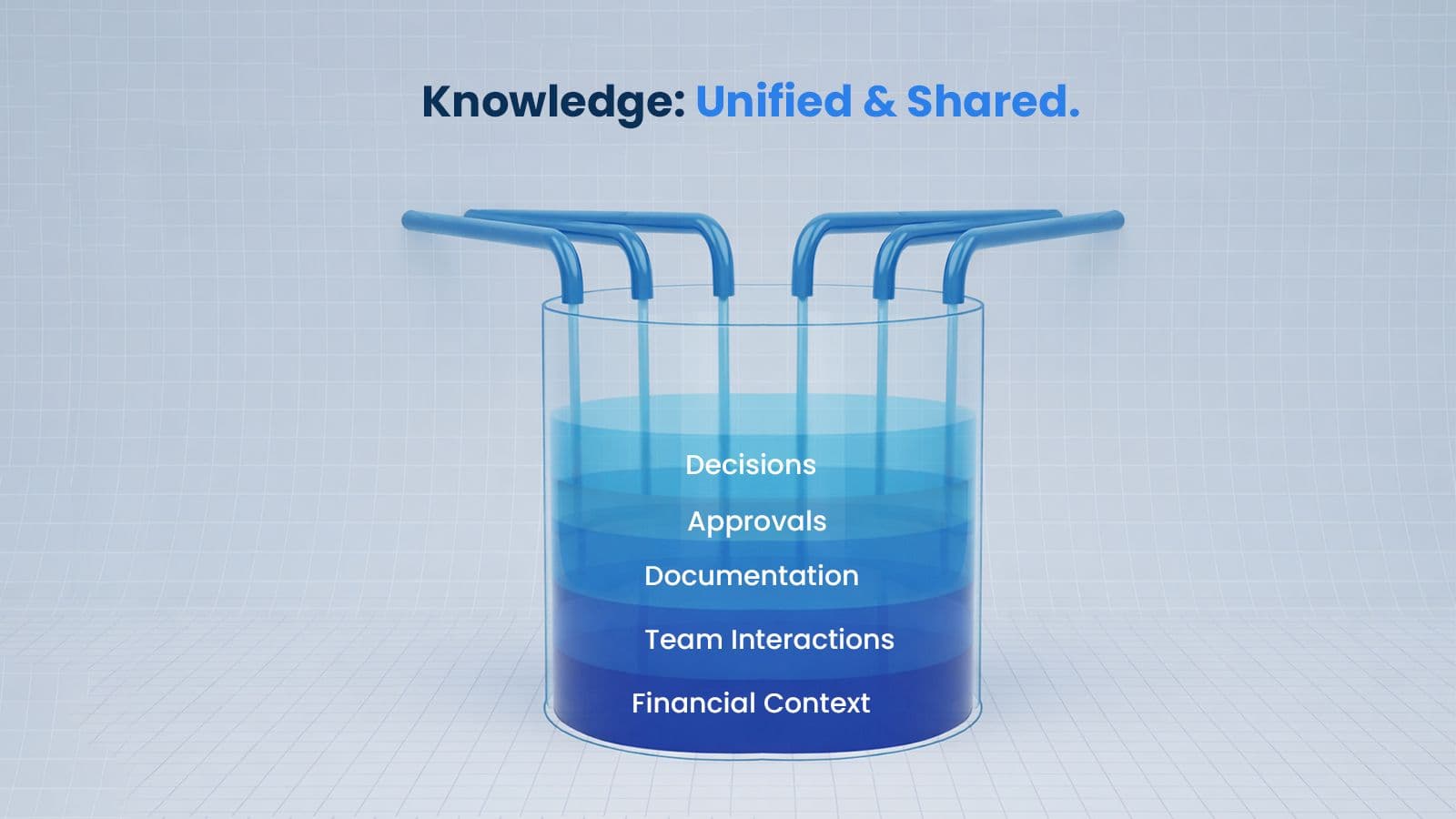
ProjectsMate captures the full life of a project: decisions, documentation, team interactions, approvals, risks, and financial context in one continuous, structured workspace. It transforms scattered project information into shared institutional memory.
When team members change, knowledge stays.When projects pause, context remains intact.When studios grow, leadership can scale without losing control.
Knowledge stops leaking. The studio becomes stronger with every project it completes.
Conclusion
Architecture studios do not struggle with knowledge transfer because of weak teams or poor intentions. They struggle because their systems were never built to protect what they learn.
Knowledge is the true engine of scalability. Studios that recognize this now and embed it into their workflows will lead the next generation of architectural practice.
Those that do not will keep rediscovering what they once already knew.
If your studio is preparing for growth in 2026 and beyond, now is the moment to turn knowledge into infrastructure and infrastructure into advantage.